Carbon Border Adjustment Mechanism (CBAM)
CBAM is a part of the European Green Deal and works on the EU’s tool for setting prices on the carbon emitted during production before entering products into the EU and it is a policy to encourage clean industrial production in EU and non-EU countries by reporting GHG emissions before to trade with the EU at CBAM transitional registry.
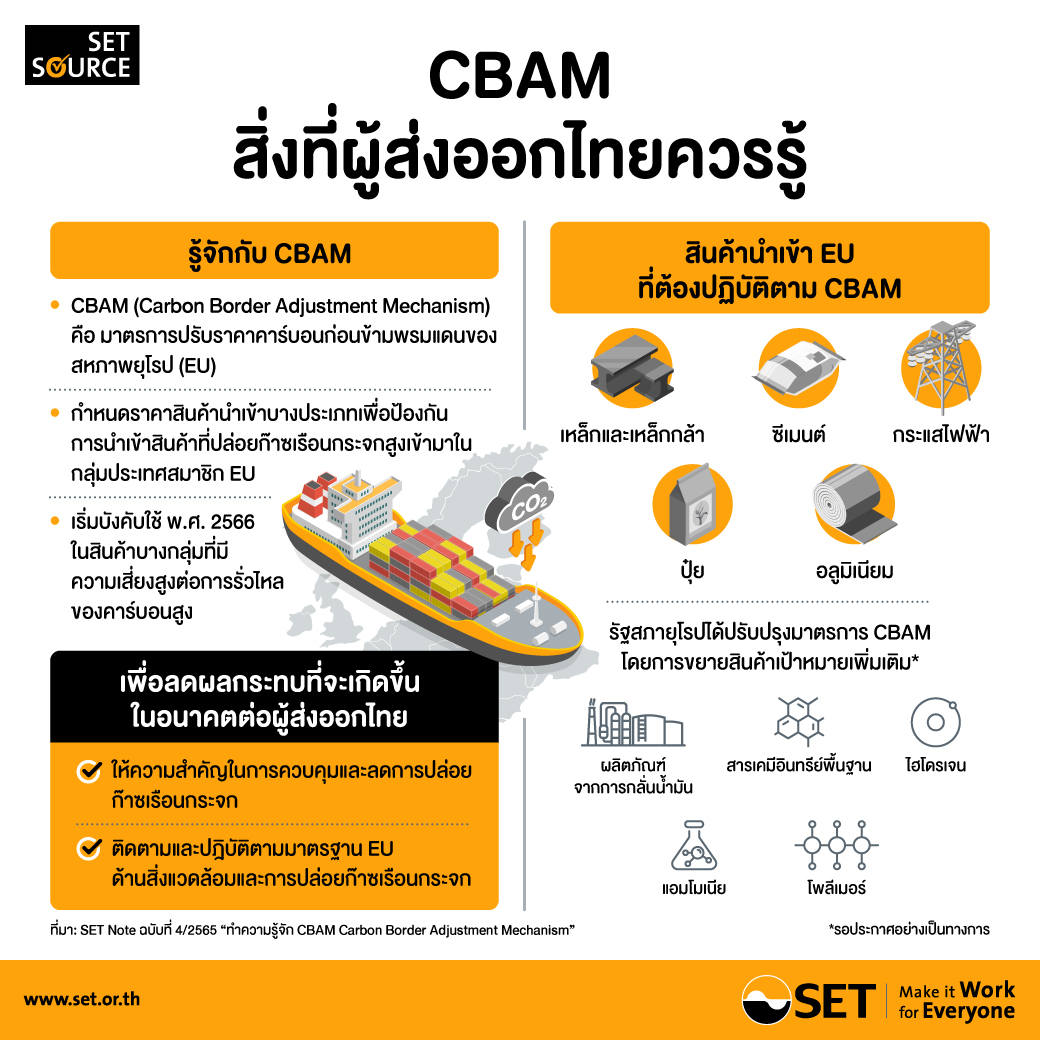
From the picture above, we can see that importing some products (industry) into the EU should comply with CBAM conditions due to the high level of GHG emissions (2023-2025):
-
Iron and steel
-
Fertilizer
-
Electricity
-
Aluminum
-
Cement
And will consider the scope increase the target industry:
-
Refinery products
-
Organic chemicals
-
Hydrogen
-
Ammonia
-
Plastic Polymers
Whose importer that needs to trade with the EU will pay more and faster carbon fees or taxation, if they can’t control carbon emitted or can’t follow the the required. For six groups of product pay fine by 10-50 EU per carbon.
This article is a part of the class “751447 SEM IN CUR ECON PROB” supervised by Asst. Prof. Napon Hongsakulvasu Faculty of Economics, Chiang Mai University.
This article was written by Sasiprapa Chaikittikhun – 621615062
References
Carbon Border Adjustment Mechanism. (n.d.). Taxation and Customs Union. https://taxation-customs.ec.europa.eu/carbon-border-adjustment-mechanism_en
CBAM มาตรการปรับราคาคาร์บอนก่อนเข้าพรมแดน อีกหนึ่งมาตรการเร่งการปรับตัวของผู้ส่งออก. (2022, May 11). ศูนย์วิจัยกสิกรไทย. https://www.kasikornresearch.com/th/analysis/k-social-media/Pages/CBAM-FB-11-05-2022.aspx
ทำความรู้จัก CBAM (Carbon Border Adjustment Mechanism) – ตลาดหลักทรัพย์แห่งประเทศไทย. (2022, July 19). SET. https://www.set.or.th/th/about/setsource/insights/article/55-cbam